


Showing posts with label news. Show all posts

Wednesday, May 25, 2011

Monday, May 02, 2011

Friday, March 18, 2011

Remembering Chernobyl

As the Japanese fight tooth and nail, heres a look at how Chernobyl looks today:

(Image credits:Pedro Moura Pinheiro via: BoredPanda)

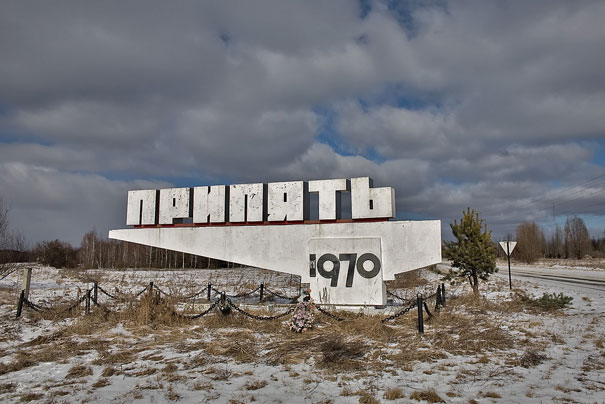
“The sign on the road to Pripyat, the town where the workers of the nuclear plant lived.”

The bridge of death

(Image credits:Vivo (Ben) via: BoredPanda)

“After the explosion at Reactor 4 the people of Pripyat flocked on the railway bridge just outside the city to get a good view of the reactor and see what had happened.

Initially, everyone was told that radiation level was minimal and that they were safe. Little did they know that much of the radiation had been blown onto this bridge in a huge spike.”

They saw a beautiful rainbow coloured flames of the burning graphite nuclear core, whose flames were higher than the smoke stack itself. All of them are dead now – they were exposed to levels of over 500 roentgens, which is a fatal dose.

P.S.: note that the photo above is made from 2 different photos (top photo of the reactor and bottom photo of the bridge in Pripyat joined together)

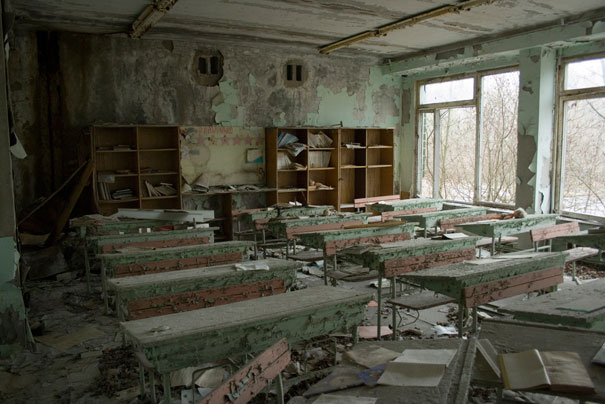
Schools

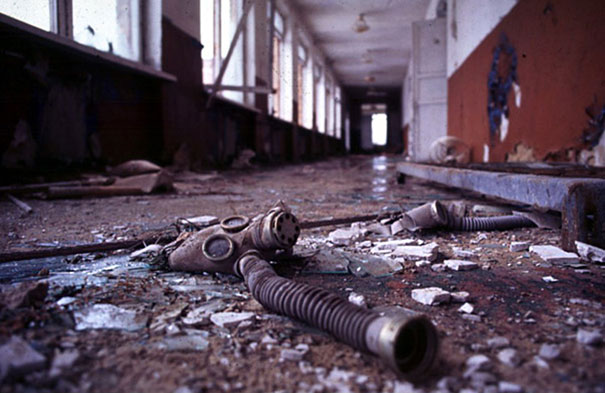
(Image credits:misterbisson via: BoredPanda)

“Deserted secondary school near Chernobyl, Illinsty, Ukraine. Dec 1995 0.96.07.01.19”

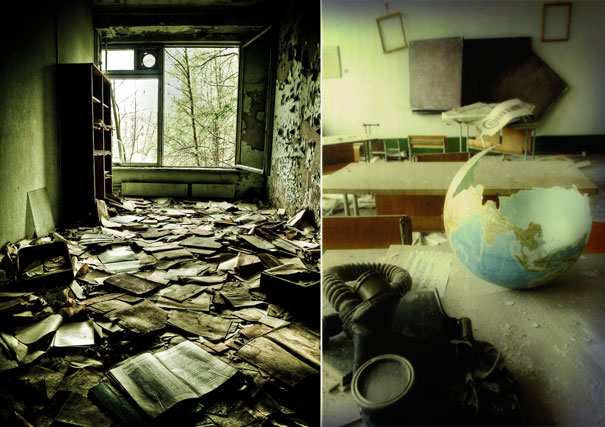
(Image credits:left: Vivo (Ben) and right: Anosmia via: BoredPanda)

Left: “One of the five schools of Pripyat, each teaching about 1000 children. The schools have remained relatively intact considering the problems with looters eight years ago. I guess books don’t hold much value to the poor. “

Right:”At a 20th anniversary Chernobyl exhibit on Capitol Hill.”

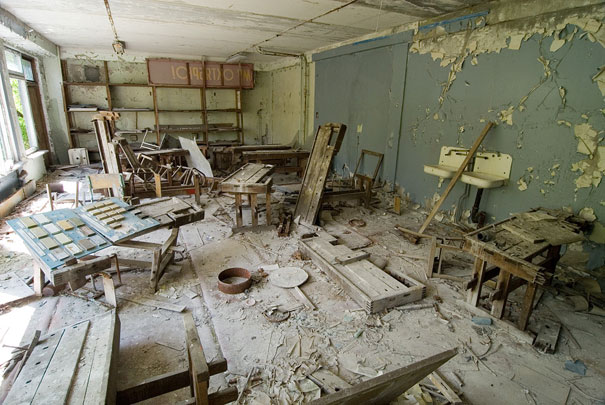
(Image credits:zbruch via: BoredPanda)

“Children will never run here again.”

(Image credits:oinkylicious via: BoredPanda)

(Image credits:Vivo (Ben) via: BoredPanda)

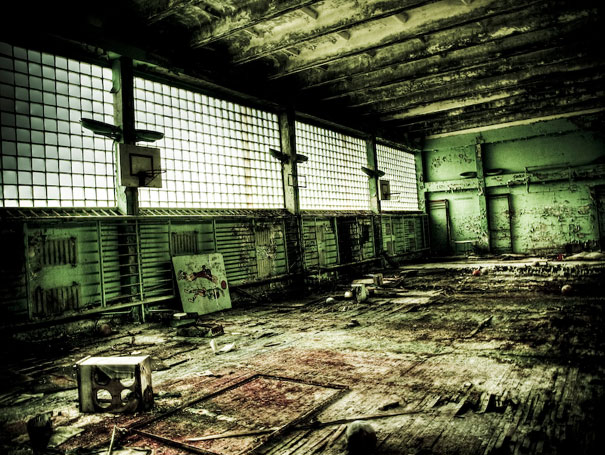
“Gym class”

Kindergarten

(Image credits:Pedro Moura Pinheiro via: BoredPanda)

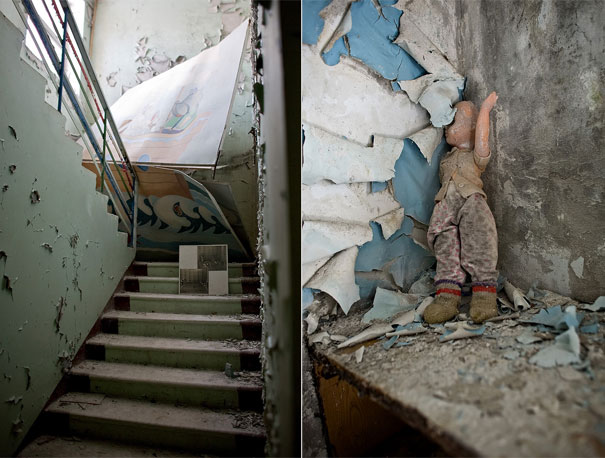
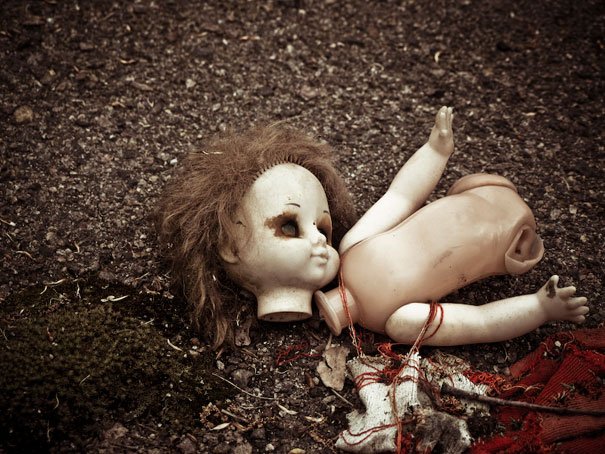
On the left: “Stairs on the creche/kindergarten near the center of Pripyat.”; on the right: “Broken doll on top of a corner cupboard in one of the rooms in the creche/kindergarten in the center of Pripyat.”

(Image credits:hanszinsli via: BoredPanda)

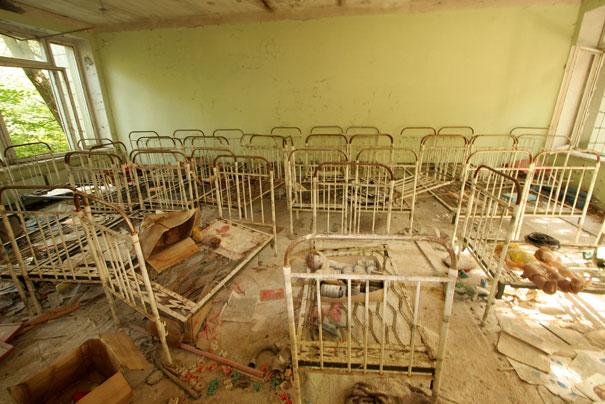
“Nursery in the creche/kindergarten”.

(Image credits:Pedro Moura Pinheiro via: BoredPanda)

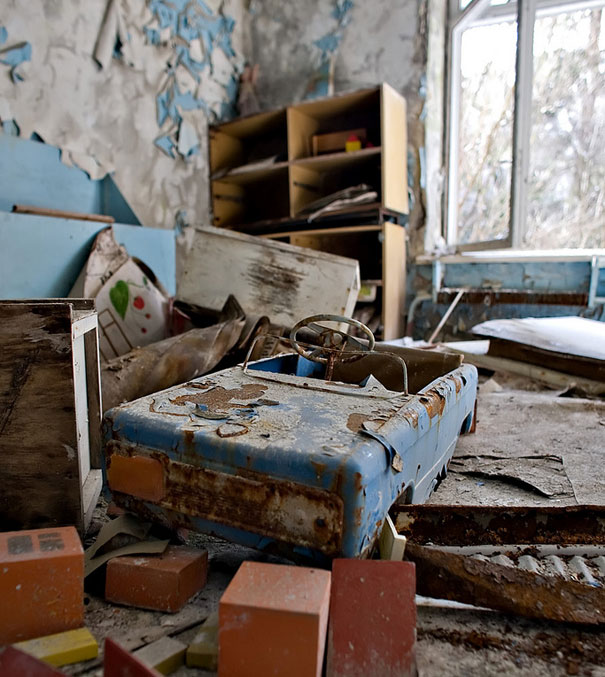
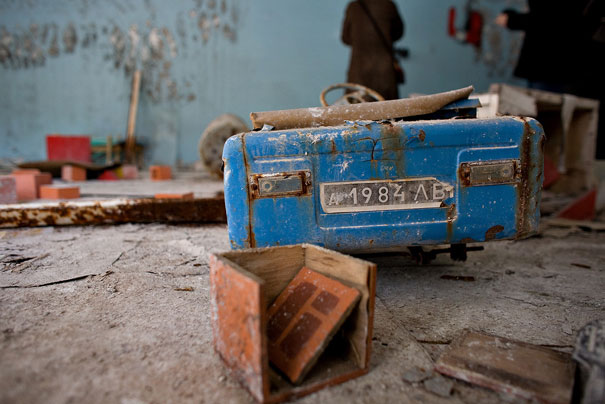
”Child’s big toy car in one of the rooms of the creche/kindergarten”. Notice the number plate of the car – 1984. It must be manufactured 2 years before the accident.

(Image credits:Pedro Moura Pinheiro via: BoredPanda)

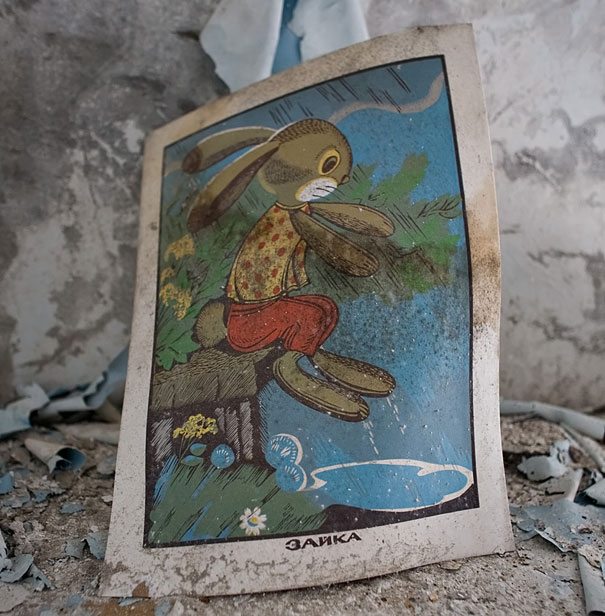
The note says “Rabbit”. I love those old-school soviet style drawings.

(Image credits:Pedro Moura Pinheiro via: BoredPanda)

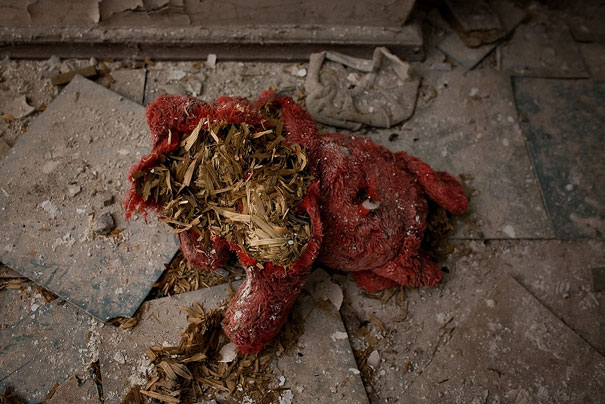
“Hay stuffed toy”.

(Image credits:Vivo (Ben) via: BoredPanda)

Pripyat funfair

(Image credits:Vivo (Ben) via: BoredPanda)

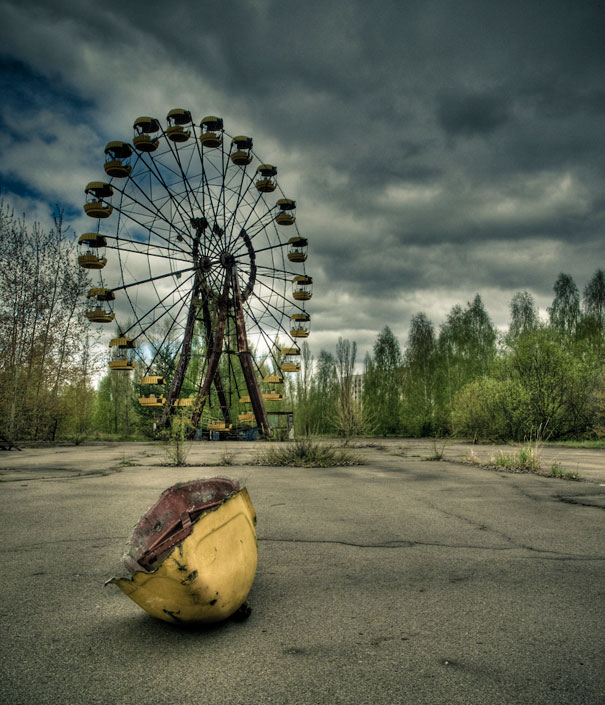
“Pripyat funfair was due to be opened on May 1st. The Chernobyl disaster happened April 26th.

No one ever managed to ride the ferries wheel. It remains one of the most irradiated parts of Pripyat since the disaster, making it still dangerous today, 22 years on.”

(Image credits:hanszinsli via: BoredPanda)

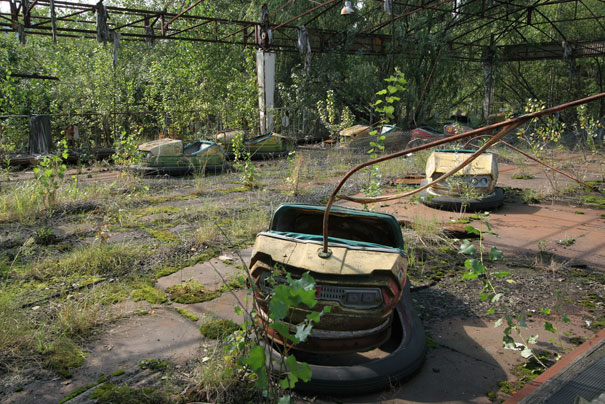
“Bumper car ride in the amusement park in central Pripyat, it was to be opened on the May 1st celebrations of 1986, five days after the accident”

(Image credits:Pedro Moura Pinheiro via: BoredPanda)

(Image credits:Pedro Moura Pinheiro via: BoredPanda)

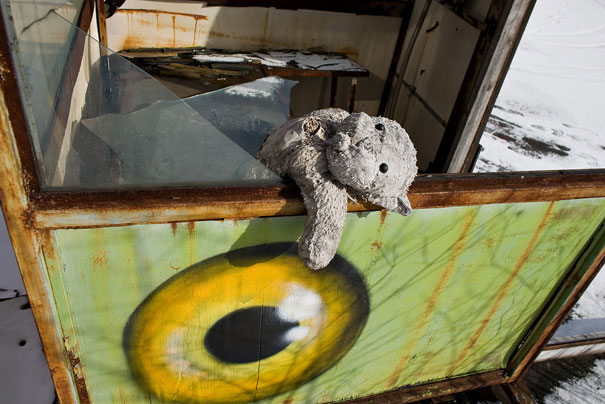
“Ferris wheel control or ticket booth in the amusement park .. I’m sure the plush teddy bear was placed there later by someone looking for an emotional photo, but it’s interesting also to document the later attempts of using the accident to achieve certain media goals.”

Hospital

(Image credits:Vivo (Ben) via: BoredPanda)

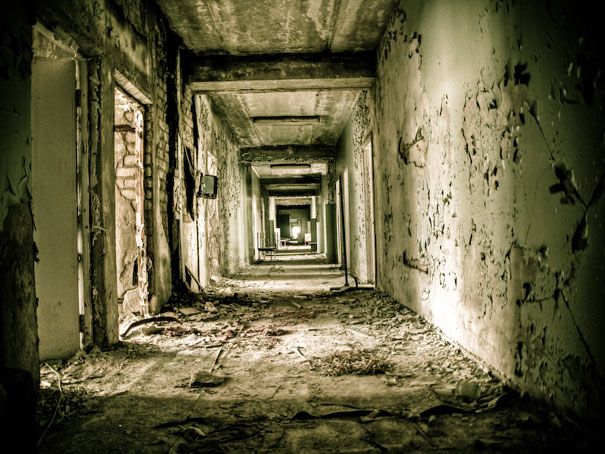
“Hospital corridor”.

(Image credits:Vivo (Ben) via: BoredPanda)

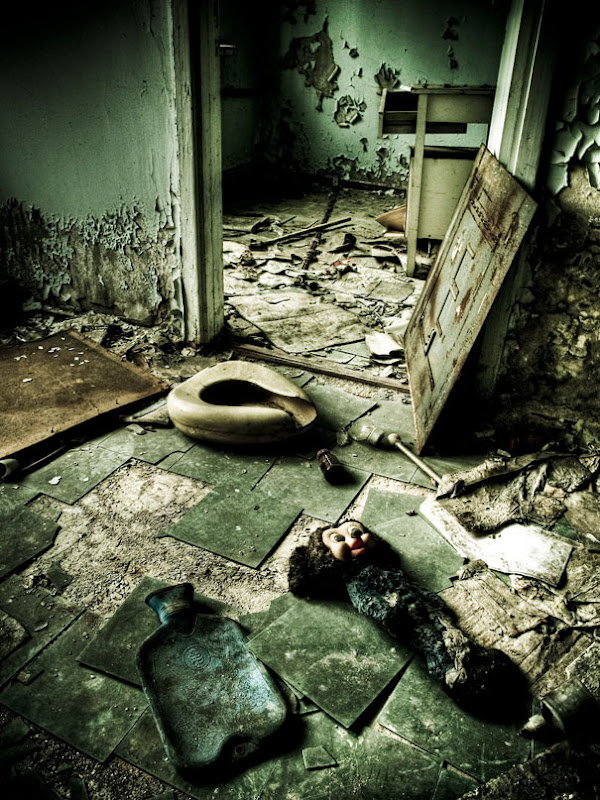
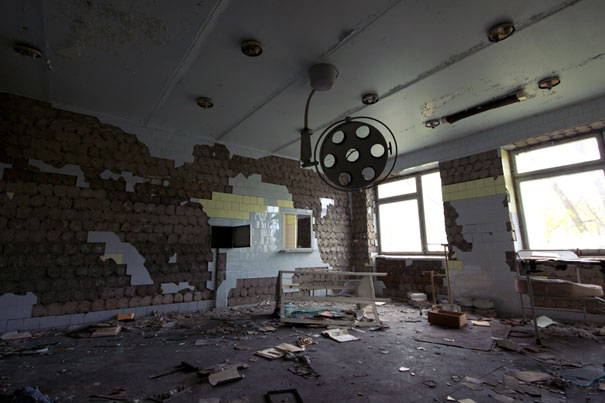
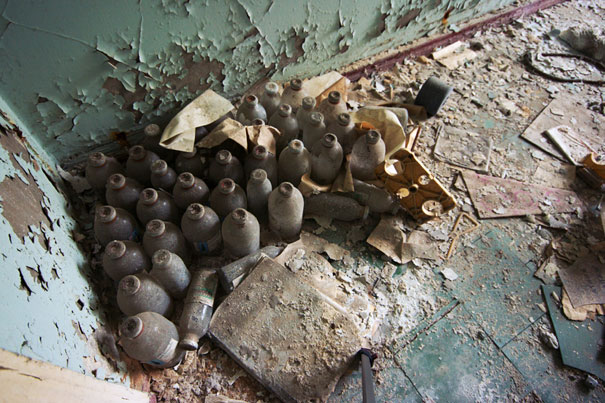
“Found just outside the surgery in the hospital. This hospital received many of Reactor 4′s first victims for treatment immediately after the explosion. The hospital itself however was already exposed to huge amounts of radiation.

Every rescue worker who attended the initial explosion was killed by radiation poisoning.”

(Image credits:abandonia via: BoredPanda)

(Image credits:abandonia via: BoredPanda)

(Image credits:abandonia via: BoredPanda)

Swimming Pool

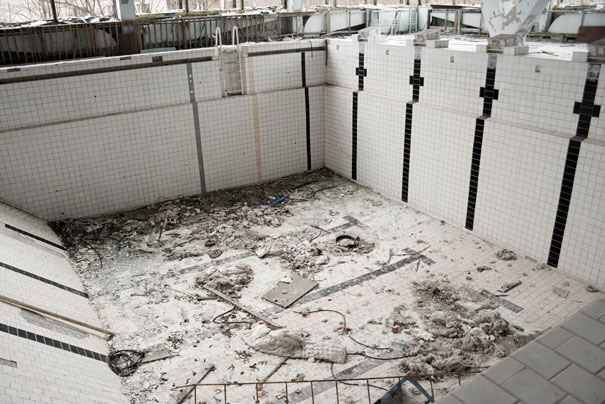
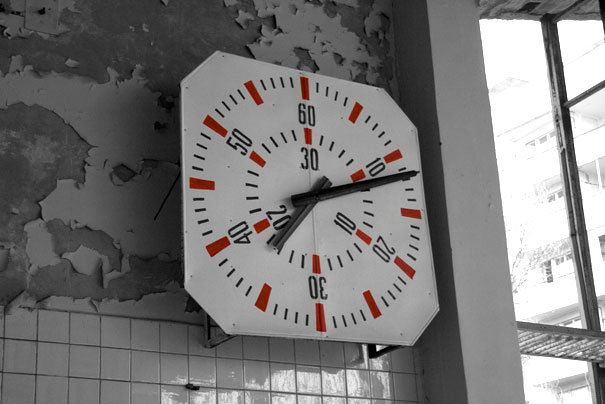
Olympic athletes must have been training here for the 70′s/80′s. The pool is really huge – this place must’ve been the best around.

(Image credits:oinkylicious via: BoredPanda)

(Image credits:oinkylicious via: BoredPanda)

Other buildings

(Image credits:rusocer via: BoredPanda)

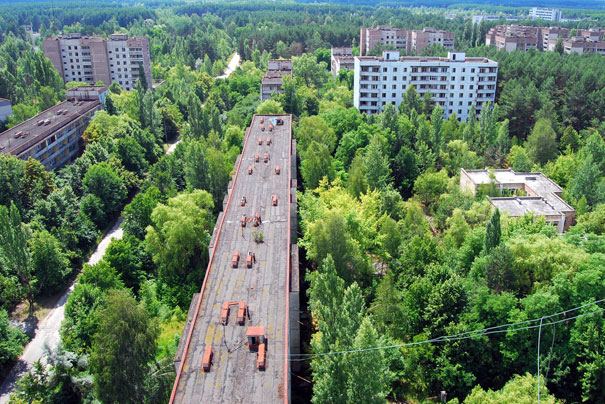
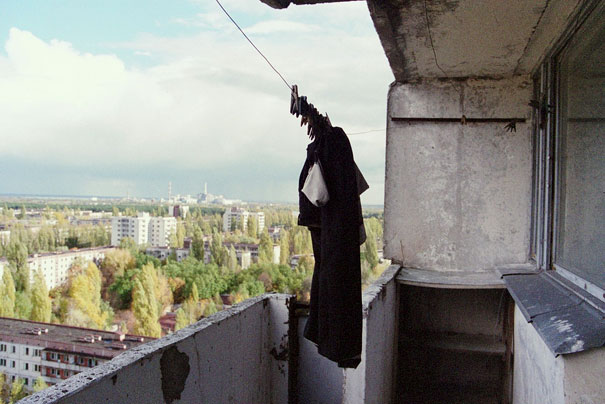
“Pripyat, ghost city abandoned after chernobyl catastrophe, has grown to a forest. nature takes over and invades and collapses human creations the views remind some apocalipthic films like I am a Legend; Views from highst building in town, a former Hotel“.

(Image credits:Stuck in Customs via: BoredPanda)

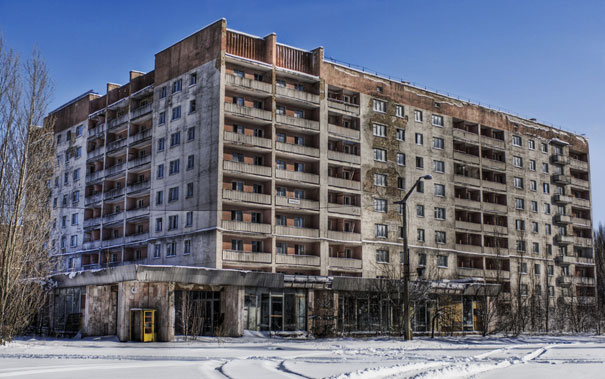
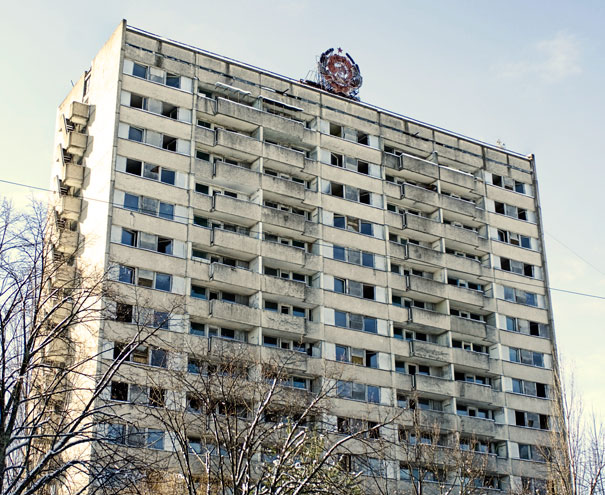
“Radiated Apartment Building”.

(Image credits:Vivo (Ben) via: BoredPanda)

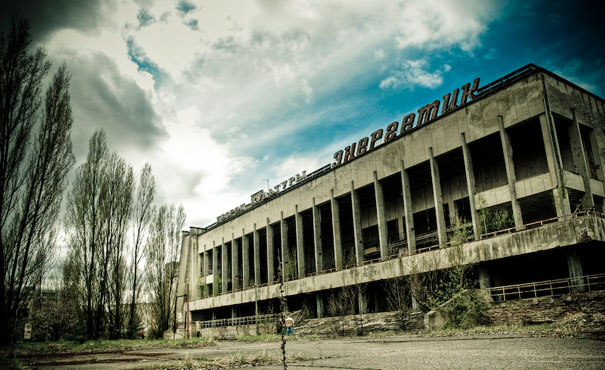
The Government have left us – “From what I saw inside, I’d presume this was the local government building. There was a political event scheduled for a few days after the explosion and there are many pamphlets and banners still inside. “

(Image credits:Vivo (Ben) via: BoredPanda)

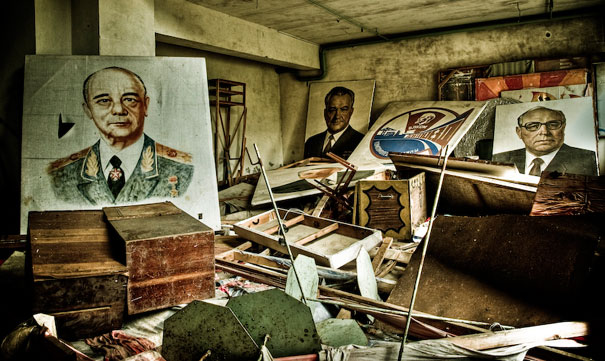
“These extremely well preserved posters are the last evidence of what the city’s inhabitants were like. I’m unsure of the details but I believe these men were politicians”.

(Image credits:Stuck in Customs via: BoredPanda)

We can see hammer and sickle on the roof.

(Image credits:Carpetblogger via: BoredPanda)

(Image credits:Pedro Moura Pinheiro via: BoredPanda)

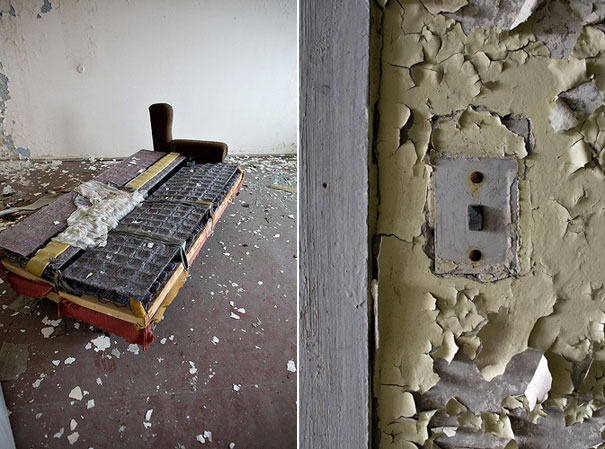
Left: “Dismantled sofa-bed in one of the apartments in the 16 story residential apartment”

Right: “Elevator call button in the 16 story residential apartment building facing the central square of Pripyat.”

(Image credits:Pedro Moura Pinheiro via: BoredPanda)

(Image credits:Pedro Moura Pinheiro via: BoredPanda)

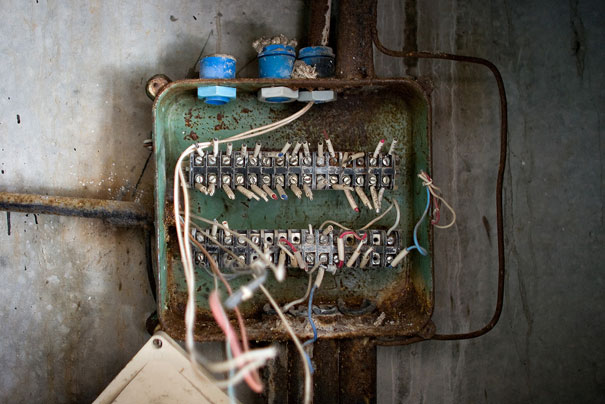
“Electrical junction box in the 16 story residential apartment building”

(Image credits:Pedro Moura Pinheiro via: BoredPanda)

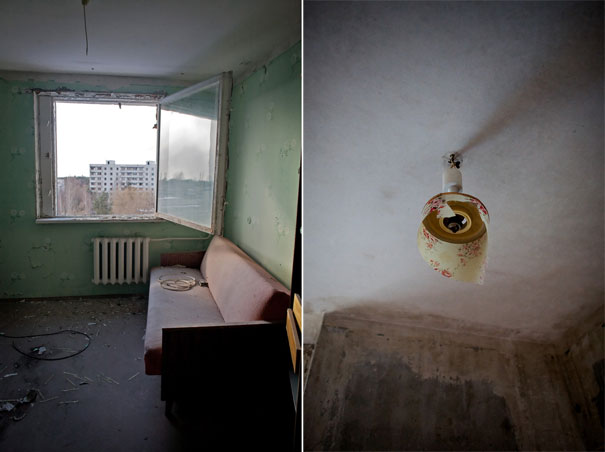
Left: “Sofa under an open back window in one of the apartments in the 16 story residential apartment building”

Right: “Broken ceiling light fixture in one of the apartments in the 16 story residential apartment”

(Image credits:Pedro Moura Pinheiro via: BoredPanda)

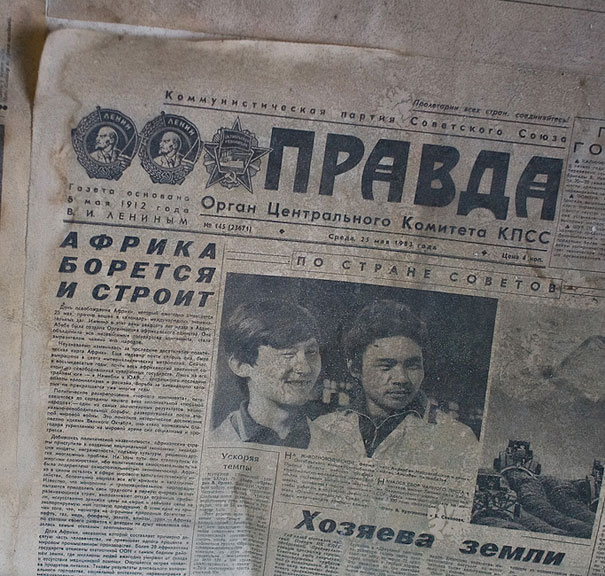
“Newspaper used as a backing to glue the wallpaper in one of the apartments in the 16 story residential apartment building facing the central square of Pripyat.”

Newspapers title: “Pravda” (Truth) – the official propaganda newspaper of the Soviet Union

Newspapers date: “Wednesday, 25th of May 1983”

Articles title on the left: “Africa fights and builds”

Other title at the bottom: “Land owners”

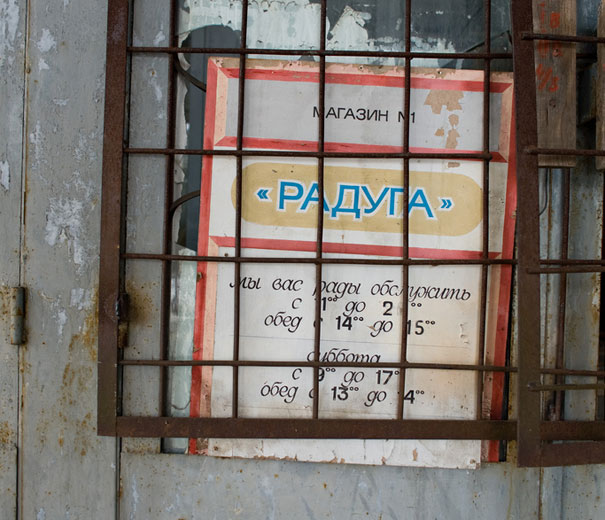
(Image credits:Pedro Moura Pinheiro via: BoredPanda)

Translations from the top to bottom:

“Store #1”

“Rainbow”

“Happy to provide service from 11 to 20 (?)

Lunch from 14 to 15”

“Saturday from 9 to 17

Lunch from 13 to 14”

(Image credits:rusocer via: BoredPanda)

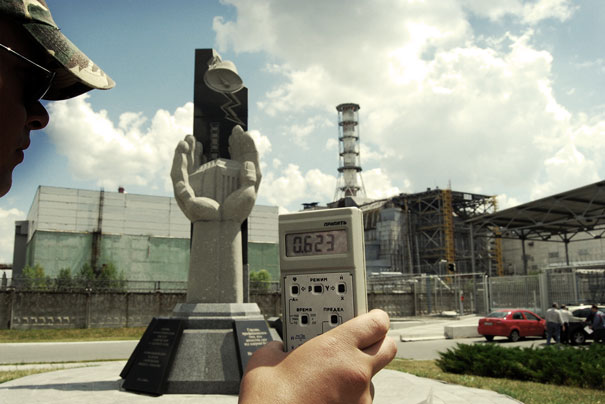
“400m away from the reactor (max allowed)” “2.0 rt being off-scale of the reader-device. average radiation level of a non contaminated area: 0.010 rt/m2″

(Image credits:Stuck in Customs via: BoredPanda)

Two more reactors, no. 5 and 6, capable of producing 1 GW each, were under construction at the time of the disaster.

Living creatures

(Image credits:rusocer via: BoredPanda)

“These whikeers-fish survived and devolped countermeasures against the deadly radiation levels of the contaminated water in the rivers surrounding Chernobyl. we didnt there to have a splash with them but we fed them big chunks of bread that were guzzled in the blink of an eye !! “.

If you want to read real stories of Chernobyl survivors you should definitely check: Voices from Chernobyl: The Oral History of a Nuclear Disaster

Tuesday, October 05, 2010

Ek doctor ki Maut

Test tube triumph & tragedy
- Nobel for UK scientist stirs memory of a Bengal doctor

Oct. 4: A British scientist has won the 2010 Medicine Nobel for research that led to the world’s first test-tube baby 32 years ago, while a Calcutta doctor who independently repeated the feat in India 10 weeks later was driven to suicide.

The Nobel Foundation today announced the award for Robert Edwards, 85, for developing in-vitro fertilisation (IVF) techniques that have helped nearly 4 million infertile couples have babies.

The award almost coincides with the anniversary of the announcement of the birth of Durga — India’s first and the world’s second test-tube baby — by reproductive scientist Subhas Mukerji on October 3, 1978.

But Mukerji was called a fraud and faced bureaucratic vindictiveness in Bengal, and took his own life on July 19, 1981, according to scientific papers and historical notes.

Edwards, a professor emeritus at Cambridge University, started working on IVF in the 1950s. He developed the technique — in which egg cells are removed from a woman, fertilised outside her body and then implanted into the womb — together with British gynaecologist Patrick Steptoe, who died in 1988.

Louise Brown, the first baby born through the procedure on July 25, 1978, in a Manchester clinic, said about the Nobel: “It’s fantastic news; me and mom are so glad. We hold Bob in great affection.”

Brown has herself given birth naturally, as have many other IVF babies — a fact the Nobel committee described as “probably the best evidence for the safety and success of IVF therapy”.

Mukerji made his own contributions to the technique. The Indian Council of Medical Research in 2005 credited him as the first in the world to use hormones to stimulate ovaries to make extra eggs, the first to harvest oocytes (eggs) through (a relatively easy) transvaginal route, and the first to freeze and thaw human embryos before transplanting them into a woman’s uterus.

Yet Mukerji and his two colleagues “were ridiculed by the medical fraternity and victimised by bureaucracy” for months after their work, a senior Indian reproductive scientist, T.C. Anand Kumar, wrote in 1997 in Current Science, a journal of the Indian Academy of Sciences.

Kumar, who played a key role in the birth of India’s first scientifically documented test-tube baby in Mumbai on August 6, 1986, had analysed Mukerji’s handwritten laboratory notes, scientific papers, and correspondence with the Bengal government.

His analysis revealed the Bengal government had appointed a panel headed by a radiophysicist — with a gynaecologist, a neurophysiologist and a physiologist as members — to examine the claims by Mukerji, who was posted at Bankura Sammilani Medical College.

None of the panel members “could have had background or insight into the modern science of reproductive technologies”, Kumar wrote, questioning the Bengal government’s rationale in appointing an expert from a “totally alien” field to head the panel.

This was just over a year after the formation of the Left Front government, which is widely held to have targeted and destroyed the standards of excellence in Bengal academia, often with the weapon of political appointments.

Since December 1978, the state authorities prevented Mukerji from presenting his work at scientific conferences and denied him permission to visit Kyoto University in Japan, which had invited him at its own expense. They transferred him in June 1981 to an institute of ophthalmology, an area where he had no expertise. Mukerji was only 50 when he hanged himself a month later.

Mukerji used to travel from Bankura to Calcutta every weekend to carry out his research with colleagues Sunit Mukherjee and gynaecologist Saroj Kanti Bhattacharya, who were at Jadavpur University and Calcutta Medical College.

“We were humiliated. There were people in the medical fraternity who wanted to crush him,” said Mukherjee, now 80. “It was Kumar’s in-depth analysis that revealed the facts.” Kumar himself died earlier this year.

Steptoe and Edwards too faced resistance from Britain’s medical establishment, which stopped their research funds, and were able to continue only thanks to a private donor.

Their work stirred an “ethical debate”, with the Vatican, other religious leaders and some scientists demanding the project be stopped. The Vatican opposed the separation of conception from the “conjugal act” and condemned the destruction of eggs that are taken from a woman’s body but not used.

Medical experts have pointed out that Mukerji’s pursuit of IVF occurred in an era when there was little awareness in India about ethical aspects of research. In his 1997 report on Mukerji’s contributions, Kumar had mentioned how Edwards would get his proposals for human experiments approved by institutional ethics committees.

Sunit Mukherjee said the embryo experiments in Calcutta did not have approval from any ethics committee. There was no culture of seeking approvals at the time, he said.

Yet the Calcutta team froze an eight-cell embryo, stored it for 53 days, thawed it and implanted it into a 31-year-old woman’s uterus. Edwards and Steptoe did not freeze the embryo, and their technique of extracting eggs from ovaries was more difficult than the one used by the Calcutta researchers, one expert said.

Edwards was not in good health when the Nobel committee tried to reach him today. “I spoke to his wife and she was delighted and she was sure he would be delighted too,” committee secretary Goran Hansson said.

It wasn’t immediately clear why the Nobel committee took so long to honour Edwards, and some experts criticised Britain for not having awarded him a knighthood. But Edwards told a newspaper in 2003 he was “not terribly bothered” about not getting a knighthood.

“I’m a very Left-wing socialist and I won’t shed a tear. But if you can organise a Nobel, please go ahead,” he joked.

Thursday, September 30, 2010

Chilling documentary

About Sweedish twin sisters who went mad in the most bizzare fashion.


Sunday, September 12, 2010

Sigh

Jawan hunts for daughter’s abductors

Patna, Sept. 11: Deputed on the international border, havildar Rajiv Ranjan Pandey has stood guard, ready to fight any enemy who could harm his countrymen. Now, sitting at home for the past two months, he is clueless how to rescue his eight-year-old daughter from an enemy who is in the hiding.

A havildar in the 2nd Bihar Regiment, Pandey alias Bhola Pandey was posted at Ranikhep on India-China border when he got the news about his daughter Shikha being abducted from the Company Sah locality of Sasaram town in Rohtas district. He left for home immediately, hoping his daughter would be rescued by the time he would reach his village.

“It’s been two months since Shikha’s abduction. I have been running from pillar to post to secure her release but the police have failed to trace the kidnappers’ whereabouts,” said Pandey.

Shikha, a Class III student of Vidya Sagar School at Sasaram, went missing from the Company Sah area on July 20. Initially a missing complaint was lodged at Modal police station.

“Soon the missing complaint was converted to a kidnapping case after the kidnappers demanded a ransom of Rs 6 lakh for the safe release of Sikha,” said Pandey.

The harried father received some information about his daughter from witnesses who claimed they saw Shikha being kidnapped by some Maruti van-borne criminals from near her house. Station house officer of Modal police station Mohammad Akram said that the girl was picked up when she was practising how to ride a bicycle in a field adjacent to Rauja Road.

With help of some local people, Pandey caught hold of one of the conspirators, Anil Pathak alias Chhotu, and handed over him to the police.

In police custody, Pathak confessed to his crime and disclosed the name of another accused, Sipahi Sharma, who was taken into custody from his village Kharari Tola under Nokha police station.

“By the time police reached Sharma’s house, the kidnappers had shifted Shikha somewhere else. Both Pathak and Sharma were later sent to jail,” said Pandey.

The army jawan is peeved at the pace of investigation. “When the two accused have admitted their involvement in the crime, why the police have not taken them on remand for further interrogation?” he asked.

Pandey is worried about the health of his wife Babita Devi. “One can well imagine the condition of a woman whose only daughter has been kidnapped and the police have failed to trace her even after 64 days,” he said.

Pathak’s role in the kidnapping case was suspected after he sought information about the cellphone number of Shikha’s grandmother soon after the incident on July 20. “Within six hours, the alleged abductors demanded a ransom of Rs 6 lakh on the mobile phone of Shikha’s grandmother,” said a police officer investigating the case.

“I had not expected such an indifferent attitude from police officers towards the case. I met many senior police officers, including the DIG and the SP, and sought their intervention. Still no step has been taken by them to recover my daughter,” Pandey said.

Rohtas Superintendent of Police Vikas Vaibhav, when contacted, said efforts are on to recover the child.

LONG WAIT

Eight-year-old Shikha was abducted on July 20 from a field in Company Sah area.

Abductors demanded Rs 6 lakh as ransom from havildar Rajiv Ranjan Pandey’s family.

Two accused -- Anil Pathak alias Chhotu and Sipahi Sharma – have been arrested.

Kidnappers still at large. Police have no information on the child’s safety.

Tuesday, September 07, 2010

One more step towards Islamophobia?

US church to go ahead with Sept. 11 Quran burning

Terry Jones AP – Rev. Terry Jones at the Dove World Outreach Center in Gainesville, Fla., Monday, Aug. 30, 2010. Jones …

GAINESVILLE, Fla. – A Christian minister vowed Tuesday to go ahead with plans to burn copies of the Quran to protest the Sept. 11 terrorist attacks despite warnings from the White House and the top U.S. general in Afghanistan that he would endanger American troops overseas.

Pastor Terry Jones of the Dove World Outreach Center, which has about 50 members, said he understands the government's concerns but plans to go forward with the burning Saturday to mark the ninth anniversary of the attacks.

He left the door open to change his mind, saying he is still praying about his decision, which was condemned Tuesday by an interfaith coalition that met in Washington to respond to a spike in anti-Muslim bigotry.

Gen. David Petraeus warned in an e-mail to The Associated Press that "images of the burning of a Quran would undoubtedly be used by extremists in Afghanistan — and around the world — to inflame public opinion and incite violence."

State Department spokesman P.J. Crowley echoed that, calling the plan to burn copies of the Quran "un-American" and saying it does not represent the views of most people in the U.S.

"While it may well be within someone's rights to take this action, we hope cooler heads will prevail," Crowley said.

Jones told the AP in a phone interview that he is also concerned but wonders how many times the U.S. can back down.

"We think it's time to turn the tables, and instead of possibly blaming us for what could happen, we put the blame where it belongs — on the people who would do it," he said. "And maybe instead of addressing us, we should address radical Islam and send a very clear warning that they are not to retaliate in any form."

Jones, who runs the small, evangelical Christian church with an anti-Islam philosophy, says he has received more than 100 death threats and has started wearing a .40-caliber pistol strapped to his hip.

The threats started not long after the 58-year-old minister proclaimed in July that he would stage "International Burn a Quran Day." Supporters have been mailing copies of the Islamic holy text to his Dove World Outreach Center to be incinerated in a bonfire that evening.

The fire department has denied Jones a required burn permit for Saturday, but he says he is going ahead with his event. He said lawyers have told him his right to burn the Quran is protected by the First Amendment whether he's got permission from the city or not.

Muslims consider the Quran to be the word of God and insist it be treated with the utmost respect, along with any printed material containing its verses or the name of Allah or the Prophet Muhammad. Any intentional damage or show of disrespect to the Quran is deeply offensive.

The interfaith group of evangelical, Roman Catholic, Jewish, and Muslim leaders meeting in Washington condemned Jones' plan to burn the Quran as a violation of American values and the Bible. Among the participants was Cardinal Theodore McCarrick, retired Catholic archbishop of Washington, D.C.; Rabbi David Saperstein of the Religious Action Center of Reform Judaism; and top officials from the Islamic Society of North America, the group that organized the gathering.

"This is not the America that we all have grown to love and care about," said Rabbi Steve Gutow of the Jewish Council for Public Affairs. "We have to stand up for our Muslim brothers and sisters and say, "This is not OK.'"

In this progressive north Florida town of 125,000 anchored by the sprawling University of Florida campus, the lanky preacher with the bushy white mustache is mostly seen as a fringe character who doesn't deserve the attention he's getting.

Still, at least two dozen Christian churches, Jewish temples and Muslim organizations in Gainesville have mobilized to plan inclusive events — some will read from the Quran at their own weekend services — to counter what Jones is doing. A student group is organizing a protest across the street from the church Saturday.

The Vatican newspaper on Tuesday published an article in which Catholic bishops, including Archbishop Lawrence John Saldanha of Lahore, Pakistan, criticized Jones' plan.

"No one burns the Quran," read the headline in Tuesday's L'Osservatore Romano.

Jones gained some local notoriety last year when he posted signs in front of his small church proclaiming "Islam is of the Devil." The church is independent of any denomination but follows the Pentecostal tradition, which teaches that the Holy Spirit can manifest itself in the modern day. Pentecostals often view themselves as engaged in spiritual warfare against satanic forces.

Jones' Quran-burning scheme, after it caught fire on the Internet, brought rebukes from Muslim nations and an avalanche of media interview requests just as an emotional debate was taking shape over the proposed Islamic center near the Ground Zero site in New York.

The Quran, according to Jones, is "evil" because it espouses something other than the Christian biblical truth and incites radical, violent behavior among Muslims.

"It's hard for people to believe, but we actually feel this is a message that we have been called to bring forth," he said last week. "And because of that, we do not feel like we can back down."

FBI agents have visited to talk about their concerns for Jones' safety, as multiple Facebook pages with thousands of members have popped up hailing him as either a hero or a dangerous pariah.

His plan has drawn formal condemnation from the world's pre-eminent Sunni Muslim institution of learning, Al-Azhar University in Egypt, whose Supreme Council accused the church of stirring up hate and discrimination and called on other American churches speak out against it. Last month, Indonesian Muslims demonstrated outside the U.S. embassy in Jakarta, threatening violence if Jones goes through with it.

___

Associated Press Writer Kimberly Dozier in Kabul, Afghanistan, and AP Religion Writer Rachel Zoll in New York contributed to this report.

(This version corrects capitalization in cardinal's last name to McCarrick.)


Friday, June 04, 2010

The Calcutta beat

Mamata Banerjee may have been crowned queen of Calcutta but it was circus queen Champa who strode majestically through the city the day after, blocking streets that the Trinamul boss has promised to keep clear even during her victory march on Saturday. Metro tracked the circus on the streets as Champa trekked from Gariahat to to Garia Bazar, throwing traffic out of gear and leaving the cops wondering under what section to book Mayawati’s mascot for trespassing on Mamata’s city…

11.32am: Champa, 30, takes over a flank of Bijon Setu with mahout Raju Singh, eight years her junior, navigating the traffic-infested concrete jungle she must cross to reach a circus that has pitched tent in Garia 11.34am: A police sergeant who had tried to stop Champa and failed walks back, walkie-talkie in hand, trying to make sense of her defiant trunk call
11.37am: Sir, er, ma’am, your licence and registration number, please, another traffic cop asks Champa and gets a jumbo ignore 12.03pm: After taking a roadside break off Bijon Setu, Raju climbs back to his perch holding Champa by the ears with her trunk supporting his legs
1.18pm: Champa gets a breather on the Bypass while an officer from Kasba police station asks forest officials if there is any provision in the Wildlife Protection Act to stop an elephant from walking down a city street. There isn’t 2.06pm: Born free and bonded to a circus but free to go for now — Champa waddles off going “chomp…chomp” on a leafy bough.